Urban planners are pushing to transform 42nd Street into a pedestrian mall, complete with its own street-level rail line.
The transformation, which advocates say would turn the clogged streets into a narrower version of an Italian piazza, would boost business on the strip by up to $500 million a year while cutting crosstown travel time in half.
Monday, October 30, 2006


Wednesday, October 18, 2006
Color is a Communication Tool

The connection between urban space and communication occurs on many levels. Industrial designer Ruth Lande Shuman founded Publicor, which has the following mission:
Publicolor is a not-for-profit organization incorporated in 1996. Our mission is to catalyze change in inner-city schools and neighborhood facilities though the power of color and collaboration. We not only transform the space but the people who use them as well. We do this through our Paint Club and COLOR Club programs which train at-risk students the marketable skill of commercial painting.
We transform public spaces in neglected schools and neighborhood facilities through the powers of vibrant color and organized collaboration. Our thoughtful designs with color create visual order in often chaotic spaces energizing the people and bringing a sense of calm through this visual landscape.
Thursday, October 12, 2006
Surveillance Cameras on Every Block

Mayor Daley is willing to bet that by 2016 Chicago will have a surveillance camera on every block in the city. This technology transforms expectations of trust, power, and the social uses of space. Late night bars, clubs, and convenience stores might be required to adopt systems that can identiy individuals. Cities have always been formed of contested spaces where some people are welcomed and others are shut out. Digital traces transform this contest of inclusion and exclusion, improving the comfort and security for some residents, diminishing the vitality and energy of other areas.
Wednesday, October 04, 2006
Interactive Social Asset Mapping

I'm originally from the Calumet Region, which stretches along the shoreline of Lake Michigan from the southside of Chicago to Michigan City, Indiana. The region has the greatest concentration of natural diversity in the United States, and some of the worst pollution. It has produced great economic wealth, but also suffers a high level of poverty. These contradictions can help to be reconciled with the right kind of communication resources. The Field Museum in Chicago helped to coordinate an innovative, participatory research program that combined the efforts of community residents, academics, and GIS and visual ethnography to create a social asset map of the region.
Saturday, September 30, 2006
Concertino for Cellular Phones and Orchestra

Composer John Cage developed a large-scale, participative music project for Chicago at Laszlo Moholy-Nagy's School of Design in the 1930s with a vision for the technological future of music.
Now U.S. jazz composer David Baker is encouraging people to use their phones during the debut performance of "Concertino for Cellular Phones and Orchestra" that will open the 20th anniversary season of the Chicago Sinfonietta classical music festival next month.
Parks, Memory and Time

A well-designed memorial creates a deeper connection between place and time, personal and public, art and politics. This project describes the design elements used to bring together the sculpture of Louise Bourgeois and the accomplishments of Jane Addams.
Thursday, September 28, 2006
Smells of the City

As Google Map mashups go, this is a great one. I could see putting this on my cell phone and cross referencing as I navigate the city's stench.
Who Cares about parks these days?

What is the future of public space in America's cities? This article picks five exemplary projects and aims to answer that very daunting question.
Thursday, September 21, 2006
EPIC 2006

As new information technologies move out of labs, corporate settings, and classrooms and ever more deeply into the everyday experience of people, the study of this phenomenon grows in importance to audiences outside the academic community. EPIC is one setting where bridges across academic/aesthetic/corporate chasms are being built. Urban communication scholars ought to have a voice in this process.
Guangshen Highway

For years, the Doors of Perception Conference has offered innovative ways of thinking about technology, design, and urban form. In this presentation (in a large pdf file) Gutierrez + Portefaix grapple with the challengees of understanding the urban from emerging from the very rapid expansion of infrastructure on a massive scale in the Pearl River Delta.
Is LA more dense than New York?

This is an argument against Robert Bruegmann's recent report, "LA the King of Sprawl, Not at All."
Traffic congestion and overcrowding are daily reminders that a lot of people live in Los Angeles. This allows the claim that the city of Los Angeles is more dense than New York City to fall on willing ears. There’s only one problem. The city of Los Angeles is NOT more dense than New York City. A recent study by UCLA urban planning students Sandra O’Flaherty, Andrea Osgood, and Lara Regus sheds some light on the facts and how confusion arises from various definitions of density.
Wednesday, September 20, 2006
Waymarkr
New technologies allow individuals the ability to easily capture, upload, and annotate everyday life to an unimagined degree. And the r at the end means it's full of web 2.0 goodness.
WayMark gives users an alternative perspective on their daily interactions by documenting continuously and effortlessly their life. All you have to do is install the Waymarkr software on your Internet enabled Series 60 mobile phone. Once the software is enabled, your phone will continously take photographs of your events and perspectives. All photographs are sent to a remote server so your phone never runs out of space. You can then login to the Waymarkr web site, annotate and share your photos, see stop motion movies of your captured event and map out where your images were taken. You can also see other user's photos that were taken at the same time and place as yours.
The New York Society for Acoustic Ecology

AudioBus B61 considers the route of the 61 bus as a computer-based sound and landscape image loop with fluidly shifting audience and live performance elements. It is designed to simultaneously collect and broadcast information associated with the experience of public transportation.
It is just one of many projects relevant to urban communication presented at Conflux in Brooklyn.
$1500 Grocery Carts

New communication contexts develop everyday, as screens are carefully engineered to meet the requirements of specific social settings. The use of screens on grocery carts raise any number of questions about parent/child relationships, attention spans, etc.
Thursday, September 14, 2006
Totems: The Communal Spirit of Black Murals

Murals are public-access stained-glass windows. They sanctify the community like the Stations of the Cross sanctify the church.- Nelson Stevens
An essay by Michael D. Harris helps document the role of murals in creating a sense of place, community, and history.
Amen Break

Making fine use of the reflexive, multi-media nature of web, Nate Harrison examines 6 seconds of music to trace connections among technology, intellectual property, and a wide range of cultural expressions in cities across several continents.
Architectures of Control
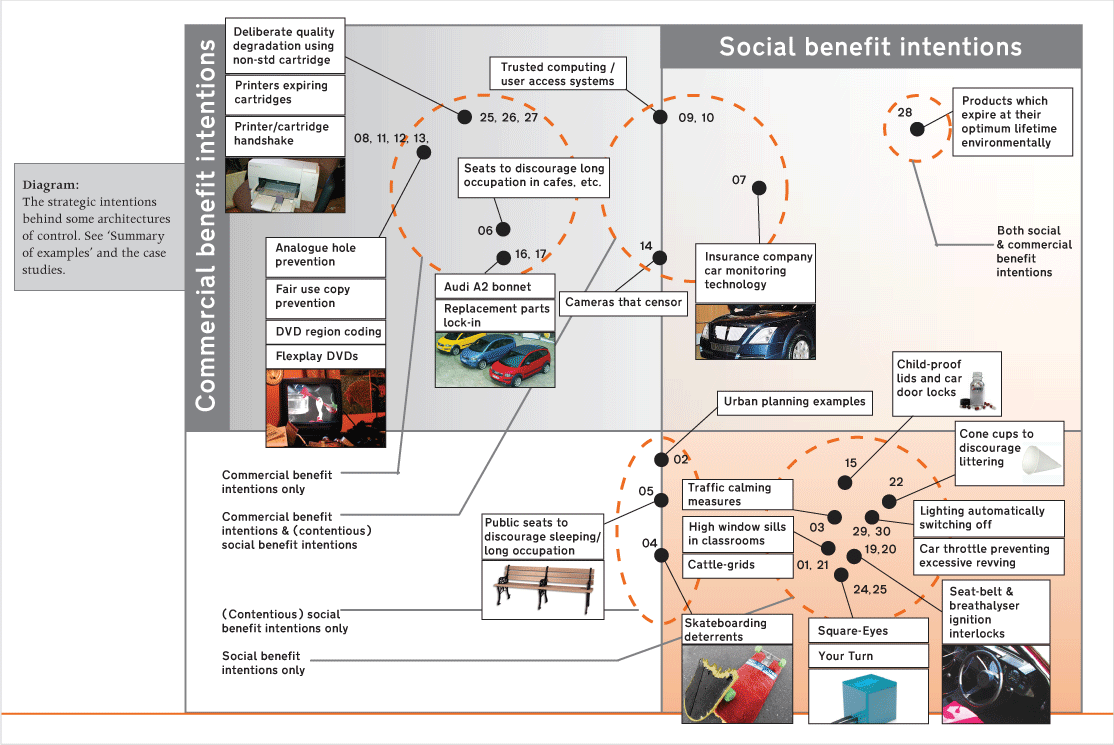
Don Lockton's web site explores how products, technologies, and cities are designed to restrict user behavior and enforce certain modes of behavior.
In Memorial: Bill Stumpf

The aeron chair gives material form to the intersection of the creative urban class and the dot com boom of the virtual world. The chair, among many other objects was designed by Bill Stumpf who passed away on August 30, 2006. Bill Stumpf helped transform the field of design through an emphasis on research-based creativity, in the service of adding more beautiful things to advance the arts of daily living.
Thursday, September 07, 2006
Millennium Park

The single most powerful icon of urban communication in my mind is Chicago's Millennium Park. Timothy Gilfoyle has written a marvelous history of all of the elements that went into the creation of this special urban space: the legislation that provided an open lakefront, the rise of the railroad infrastructure that brought economic wealth and cultural clout to Chicago and the subsequent decline that left a ghostly space in the heart of the city, the public private investments needed to fund the park, the impact of globalization on local corporate philanthropy, and the aesthetic vision that informed contemporary sculpture suitable to the scale of the park.
If we are lucky, in five years a scholar will write a book documenting the use of this park as a site of urban communication, which varies in scale from crowds of hundreds of thousands that come together to mark civic holidays to single individuals contemplating the water garden, and range from the high culture of a restored black and white print of Sergei Eisenstein's 1925 classic Battleship Potemkin backed by a symphony orchestra to the simple joy of a Chicago style hotdog.

Logic + Emotion
Urban communication intersects with a host of specialized knowledge communities. Web content developers, interactive marketing companies, and interactive experience designers play an increasingly important role in reshaping the communication spaces we inhabit. Logic + Emotion, a blog created by David Armano, provides an interesting window into this process which
exists at the intersection of Marketing 2.0, Brand Engagement and Experience Design—where passive consumers are transformed into active participants."
Subscribe to:
Posts (Atom)